
Earth’s South Atlantic Magnetic Weak Zone is expanding - new study
The anomaly increases the radiation exposure risks for satellites and space missions that pass through it.
Scientists report that a well-known weak region in Earth’s magnetic field — the South Atlantic Anomaly (SAA) — is expanding more rapidly than previously thought, says a new study published in the journal Physics of the Earth and Planetary Interiors. The SAA is a region above the South Atlantic Ocean and parts of South America and Africa where Earth’s magnetic field is unusually weak.
This weak zone arises because Earth’s magnetic field — generated deep inside by molten iron circulating in the outer core — is not uniform. Local variations in the core’s flow can create patches where the field strength dips.
More to read:
China’s hidden power to slow Earth’s rotation
What new research shows
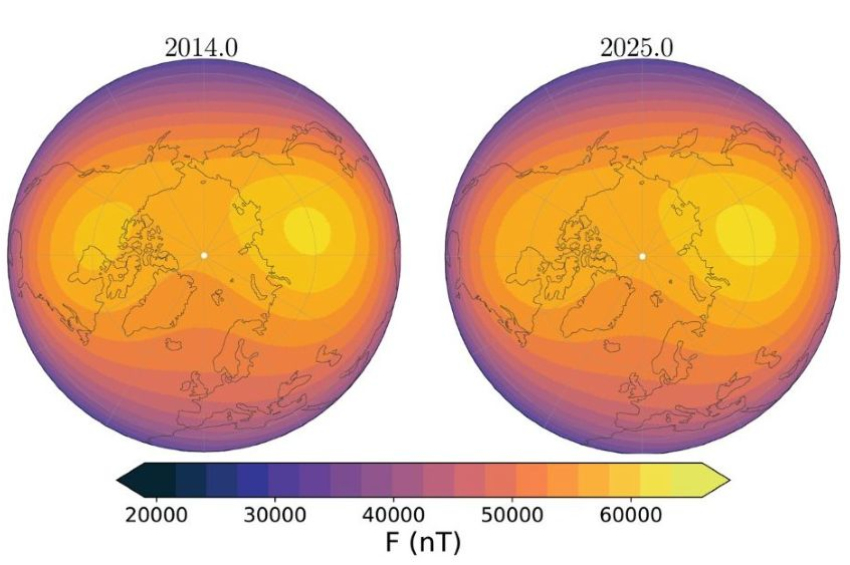
Using data from the three-satellite Swarm constellation over the period 2014–2025, scientists have mapped how this weak area has changed in recent years. The results are published in the journal Physics of the Earth and Planetary Interiors.
According to lead researcher Chris Finlay, “the region of weak magnetic field in the South Atlantic has continued to increase in size over the past 11 years since the launch of the Swarm satellite constellation.”
The study shows that since 2014 the SAA has expanded by an area roughly equal to half the size of continental Europe, and that the weakest-field region has dropped further in intensity.
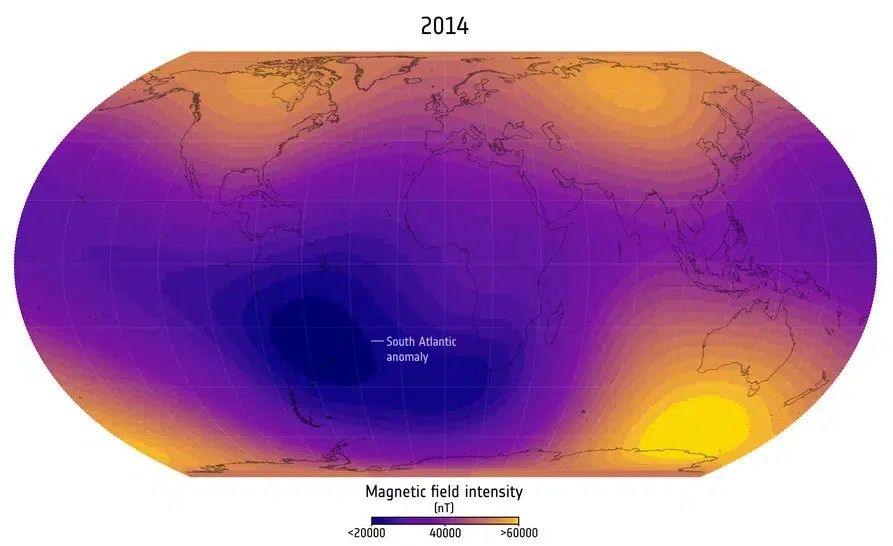
Moreover, the expansion is not uniform: the portion of the anomaly near southwestern Africa has weakened more rapidly since around 2020 than the part over South America. “The South Atlantic Anomaly is not just a single block,” Finlay explains.
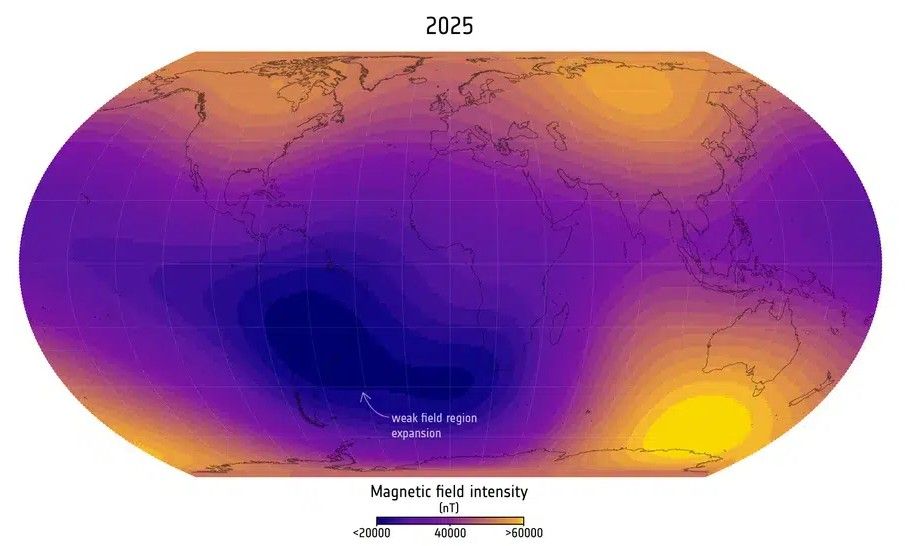
The authors representing the Technical University of Denmark and the Grenoble Alps University in France link this behavior to subtle and shifting flow patterns of liquid metal at the boundary between Earth’s outer core and its mantle — including so-called “reverse flux patches,” where magnetic field lines dive back into the core instead of emerging outward. One such patch appears to be drifting westward beneath Africa, intensifying the weakening there.
Why it matters
The weakening magnetic field in the SAA matters because Earth’s magnetosphere serves as a protective shield, deflecting charged particles from the Sun and space. In the weakened zone, that protection is reduced.
More to read:
Scientists believe chunks of proto-Earth are buried deep beneath the planet’s crust
Satellites — including those in low-Earth orbit — passing through the anomaly are exposed to higher radiation doses. This can lead to electronic glitches, data corruption, or temporary blackouts.
Because the SAA is expanding, future spacecraft and satellite missions may need extra radiation shielding or design adjustments, especially if they will spend time traversing this region.
Despite the rapid growth of the anomaly, scientists stress this is not evidence that Earth’s magnetic field is about to reverse. The current changes are viewed as part of normal long-term fluctuations in the geomagnetic field — driven by shifting flows in Earth’s outer core.
The magnetic field also appears to be strengthening in other regions — such as over Siberia — which suggests a re-balancing rather than a global collapse.