
Orcas and dolphins form a tactical hunting alliance in the Pacific Northwest – research finds
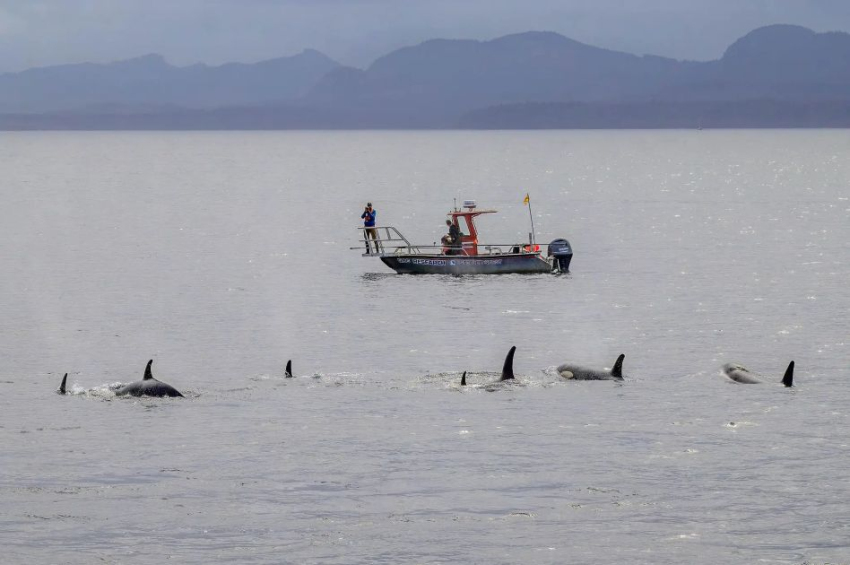
New underwater footage suggests that Pacific white-sided dolphins help resident killer whales locate and catch Chinook salmon — looking instead for protection against mammal-hunting Bigg’s killer whales.
In the coastal waters off British Columbia, resident killer whales and Pacific white-sided dolphins appear to have moved from mere toleration to forage business cooperation. According to a new study published in the journal Scientific Reports, the two species may engage in an opportunistic alliance that helps orcas locate hard-to-catch Chinook salmon and allows dolphins to share in the rewards.
Another reason why the dolphins swim alongside the resident killer whales – which eat fish but don’t prey on mammals – is the relative safety against Bigg’s killer whales, which hunt marine mammals, including sea lions, porpoises and dolphins.
Both whale populations swim the same waters but avoid each other.
More to read:
Chernobyl frogs adapted to high radiation exposure
From the surface, the interactions can look chaotic. But underwater recordings reveal a coordinated dynamic in which dolphins may act as scouts, guiding killer whales to prey at depth.
“Sometimes you can have an unlikely friend that helps guide you to a buffet or takes you to an underground speakeasy,” said Dr. Sarah Fortune, a marine ecologist at Dalhousie University and lead author of the study.
Rethinking a misunderstood relationship
Pacific white-sided dolphins — known for their speed, acrobatics, and distinctive white markings — are frequently observed alongside fish-eating resident orcas in the Pacific Northwest. Until now, scientists largely assumed the dolphins were either harassing the whales or stealing their prey.
The new findings challenge that view. Both species invest time and energy in this foraging activity, but in the documented cases, the dolphin were not stealing from orcs to get a “free lunch” – they worked together as a team.
Cameras, tags, and drones reveal underwater coordination
More to read:
Male capuchin monkeys on Jicarón Island are kidnapping baby howlers (and let them die)
To document the behavior, researchers deployed suction-cup tags on resident killer whales off Vancouver Island. Each tag carried a camera and acoustic recorder, capturing underwater video and vocalizations, while drones filmed from above.
The combined footage allowed scientists to track when dolphins were near tagged whales, monitor echolocation clicks, and observe whether dolphins were present when whales surfaced with prey.
The team identified 25 instances in which killer whales trailed dolphins during foraging hunts. When dolphins dove, the whales followed. At greater depths — where Chinook salmon are often caught — the dolphins swam alongside the whales, emitting echolocation clicks and homing in on fish targets.
In eight documented cases, orcas caught and shared Chinook salmon with other whales. Dolphins were present for four of those events, scavenging fish scraps in at least one instance.
More to read:
[video] Sharing tools sheds light on learning and evolution. The case of chimpanzees
Echolocation as a shared information channel
Acoustic recordings revealed that dolphins and killer whales alternated periods of echolocation rather than clicking continuously at the same time.
The researchers hypothesized that it could be that they were eavesdropping on each other – a dolphin’s echolocation clicks could allow a nearby killer whale to detect returning echoes and infer the location of a fish — and potentially the reverse.
The study stops short of definitively proving a permanent cooperation between the two different species. It’s either unclear whether such beneficial interactions had happened before or are the outcome of recent evolutionary drivers.
The findings highlight the complexity of marine ecosystems and the nuanced strategies animals use to survive.
More to read:
Why are salmon increasingly spawning in Arctic rivers?
Services for safety
Dolphins usually inhabit environments where they must constantly hunt, evade predators, and assess risk.
In the same waters, a different population — Bigg’s killer whales — preys on marine mammals, such as sea lions, porpoises, and dolphins. Although fish-eating resident orcas and Bigg’s killer whales share the region, they tend to avoid one another, providing a safety opportunity for dolphins.
“It could be that the dolphins are having some sort of refuge with the fish-eating killer whales,” Dr. Erin Ashe, a marine conservation scientist at the nonprofit Oceans Initiative, said. “The refuge might allow dolphins to get close to killer whales that don’t pose a threat. They can sort of size up their predator on some level.”
Together, the findings suggest that even apex predators — and their potential prey — may form flexible, situational alliances, revealing a level of interspecies coordination that scientists are only beginning to understand.
You may support our small reporting project via BuyMeCoffee. Any amount is welcome.