
Astronomers discover how some planets create their own oceans
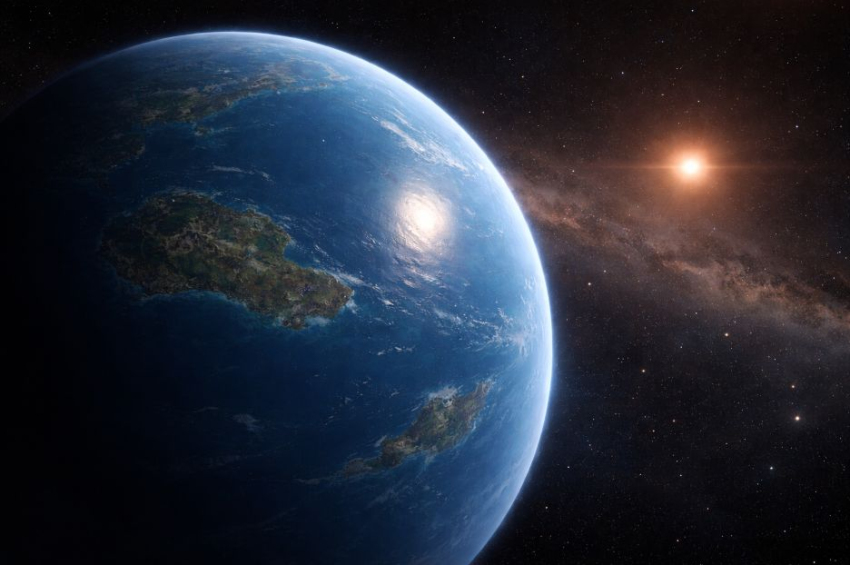
New research reveals that sub-Neptune exoplanets can form vast amounts of water internally.
A team of astronomers from the United States and Israel has uncovered a surprising mechanism that explains how certain exoplanets can be rich in water—even when they orbit so close to their stars that liquid water should not be able to survive.
A new study, published in the journal Nature, reveals that some planets may be producing water internally, overturning long-standing assumptions about how planetary oceans form.
The research focuses on a class of worlds known as sub-Neptunes: planets larger than Earth but smaller than Neptune, often surrounded by thick, hydrogen-rich atmospheres. Many of these planets orbit extremely close to their host stars, where intense heat was previously thought to prevent the retention of water.
More to read:
James Webb Telescope detects potential biosignatures on exoplanet K2-18b
Yet observations from NASA’s Kepler mission have consistently indicated that some of these planets contain vast amounts of it.
A challenge to traditional theories
Until now, scientists believed that planets acquired water in one of two ways: either through impacts from water-rich comets and asteroids, or by forming farther from their stars—where ice is abundant—and later migrating inward.
While these processes can explain water on planets like Earth, they struggle to account for the unexpectedly high-water content found on sub-Neptunes orbiting close to their stars.
The new study, led by researchers from Arizona State University with contributions from the Open University of Israel and the University of Chicago, proposes a fundamentally different explanation. Rather than relying on external delivery, these planets may be generating water themselves.
How sub-Neptunes make water
According to the astronomers, water can form deep inside sub-Neptunes through chemical reactions occurring at the boundary between the planet’s rocky core and its hydrogen-rich atmosphere. Under extreme pressures and temperatures, hydrogen from the atmosphere interacts with minerals in the rocky interior, triggering reactions that produce water internally.
This process challenges the assumption that water must be inherited during a planet’s formation or delivered later by impacts. Instead, it suggests that water can emerge naturally as a byproduct of a planet’s internal chemistry.
Laboratory evidence
To test this idea, the team conducted experiments at the University of Chicago’s Advanced Photon Source synchrotron facility. Using diamond-anvil cells, they recreated the extreme environments found inside sub-Neptunes—pressures up to 10,000 times greater than Earth’s atmospheric pressure and temperatures exceeding 3,000 Kelvin (2,726.85 degrees Celsius).
More to read:
Red dwarfs are dangerous hosts to exoplanets
Under these conditions, the researchers observed that oxygen released from molten silicate rock reacts efficiently with hydrogen. As the study notes, this process produces “an appreciable amount of water up to a few tens of weight per cent, which is much greater than previously predicted.”
The experiments showed that these reactions are far more efficient at high pressures than under surface-level conditions, suggesting that sub-Neptunes could generate significant quantities of water over billions of years.
Implications
If sub-Neptunes can indeed manufacture their own water, the number of potentially water-rich exoplanets in the galaxy may be far higher than previously assumed. This has important implications for the search for habitable worlds, as liquid water is a fundamental ingredient for life as we know it.
The findings also suggest that sub-Neptunes may represent an early evolutionary stage of water-rich planets, rather than a fundamentally distinct category. In other words, worlds once thought too hot and hostile for water may, in fact, be quietly creating oceans from within.