
Cornell University designs the world’s first microwave-powered chip

It promises faster, low-energy computing.
Scientists at Cornell University in the United States have built the first computer chip that uses microwaves — not standard digital circuits — to perform calculations, offering a faster and far more energy-efficient alternative to today’s CPUs.
The device, as described in the journal Nature Electronics, is the first fully functional microwave neural network (MNN) small enough to fit on a chip. Researchers say in a press release it could power future AI tools, radar systems, and wireless communications.
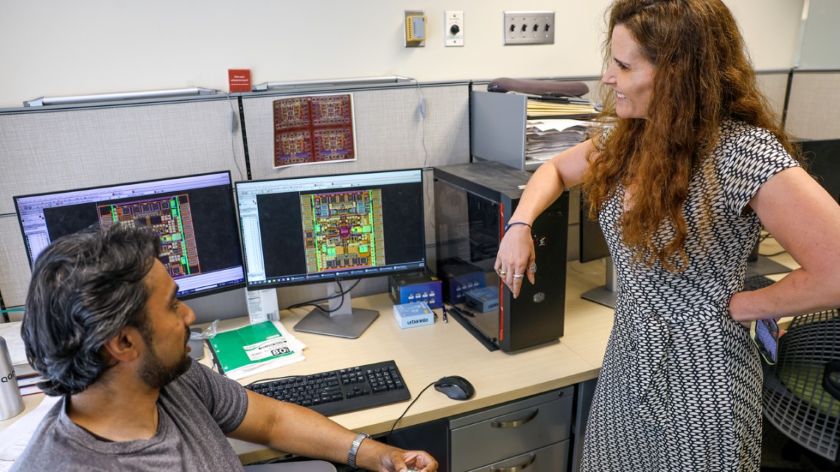
The first-of-its-kind microwave neural network that is fully integrated on a silicon microchip was created by Bal Govind, doctoral student, and Alyssa Apsel, the Ellis L. Phillips Sr. Director of the School of Electrical and Computer Engineering. Credit: Conell University
Microwaves operate in the analog spectrum and can process large amounts of data at high speed, making them ideal for tasks like radar imaging. The new chip uses programmable microwave signals to handle calculations instantly.
"Because it's able to distort in a programmable way across a wide band of frequencies instantaneously, it can be repurposed for several computing tasks," lead author Bal Govind of Cornell University was quoted as saying.
"It bypasses a large number of signal processing steps that digital computers normally have to do."
Inside the chip, microwave waves move through tunable electromagnetic pathways that act like a neural network. These signals produce a “frequency comb,” a set of evenly spaced spectral lines that help the system quickly detect patterns in data.
More to read:
AI designed in hours strange wireless chips that outperform human creations
The chip successfully performed logic operations and complex tasks such as identifying high-speed data patterns with 88% accuracy. It can process signals in the tens of gigahertz — over 20 billion operations per second — much faster than typical home CPUs running at 2.5 to 4 GHz.
Traditional digital systems require more hardware, power, and error correction, while the team’s probabilistic approach keeps accuracy high without adding extra components.
More to read:
Google’s new chip could control all Bitcoin, if it had a quantum computer
The chip uses under 200 milliwatts of power — about the same as a smartphone and far below the 65 watts or more drawn by standard CPUs. This efficiency could make it suitable for personal devices, wearables, and edge-computing systems that operate without relying on cloud servers. It may also offer a low-energy option for running or training AI models.
The next step for the researchers is to shrink the chip further and reduce the number of waveguides, which could improve performance and help train the neural network more effectively.