When guns fall silent: Can the 1914 Christmas truce serve as a precedent in the Russo-Ukrainian war?
More than a century ago, in the opening months of the World War I in Europe, tens of thousands of soldiers briefly put their arms aside in an extraordinary display of shared humanity. Is this possible today in Ukraine?
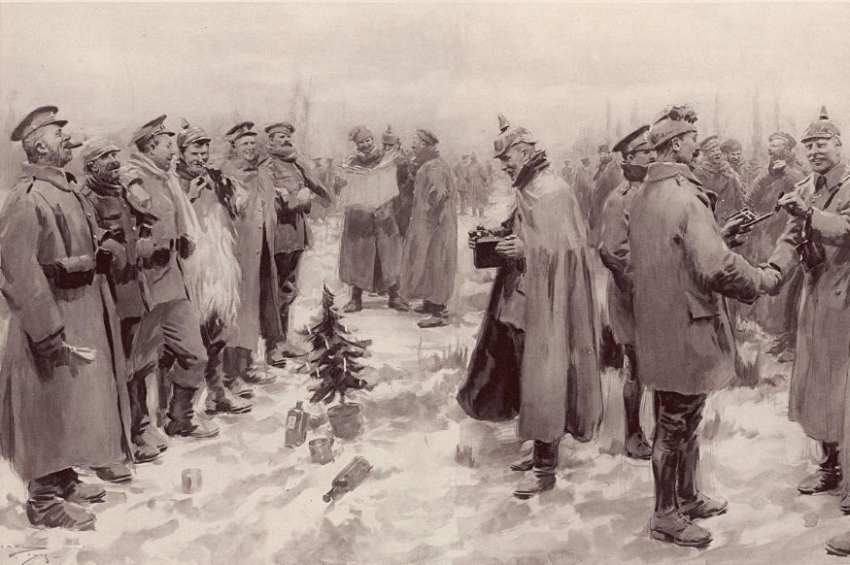
In December 1914, an unofficial and largely spontaneous ceasefire spread across large stretches of both the Western and Eastern fronts, prompting British, German, and in some areas French and Belgian troops to pause the fighting around Christmas.
Soldiers emerged from their trenches to exchange greetings, food, tobacco, and small personal items. Artillery fire fell silent, and joint burial ceremonies were held for the dead lying between the lines. In several sectors, opposing troops sang Christmas carols together.
The ceasefire was not sanctioned by military command on either side; on the contrary, many officers watched with unease, warning that fraternization undermined discipline and threatened morale.
More to read:
Ex commander-in-chief of Ukraine’s armed forces names bold security guarantees his country needs
The truce grew out of a specific wartime moment. Following the Battle of the Marne, the front had frozen into a vast trench system stretching from the North Sea to Switzerland. By winter, exhaustion, shortages of men and ammunition, and the grim reality of industrial warfare had taken hold.
Informal “live and let live” practices had already appeared in quieter sectors, and Christmas briefly amplified this fragile impulse. The truce faded quickly, largely suppressed by commanders in subsequent years, but the episode endured as a powerful symbol of humanity amid mass violence.
Then and now
That legacy inevitably invites comparison today. As Europe faces its most destructive war since 1945, the following question arises: if enemies could temporarily silence their guns in 1914, could something similar emerge in the ongoing Russo-Ukrainian war?
The war in Ukraine is fundamentally different. A century on, the conditions that made the great Christmas truce possible are largely absent — and the symbolic foundations for such a moment scarcely exist.
In 1914, static trench warfare placed opposing soldiers in close proximity, often within shouting distance, allowing informal contact beyond the immediate control of higher command. The conflict had not yet hardened into a fully ideologized war of annihilation.
More to read:
Russia forcefully indoctrinates, militarizes and sexually abuses abducted Ukrainian children
The front lines in Ukraine are deeper, more fluid, and are dominated by long-range artillery, drones, precision strikes, and constant surveillance. Sustained face-to-face contact between opposing infantry units is rare.
Any unsanctioned movement into contested areas is likely to be detected and met with lethal force within minutes. These technological realities alone leave little room for spontaneous, local ceasefires.
There is also a profound symbolic and psychological divide. Ukrainians and Russians no longer even mark Christmas on the same day: Ukraine now observes it on 25 December, while Russia continues to celebrate on 7 January. What might once have been a shared cultural and religious patrimony has become another marker of separation.
More decisively, the war is shaped by ideology and trauma. Russian servicemen operate in an information environment saturated with state propaganda portraying Ukrainians as “Nazis,” a narrative that dehumanizes the enemy and discourages any sense of shared identity.
Ukrainians, meanwhile, are fighting a defensive war defined by national survival, occupation, and well-documented war crimes and civilian massacres. For many, the scale of violence has extinguished the possibility of forgiveness, let alone fraternization.
Mission impossible
After four years of full-scale combat, the cumulative toll is overwhelming. Hundreds of thousands of deaths, mass displacement, destroyed cities, and personal loss have embedded levels of anger and grief that cannot be ignored for symbolic gestures of peace. Unlike in 1914, this is not a war that feels distant or abstract.
However, isolated acts of restraint are not impossible. As in other modern conflicts, brief, tacit pauses to recover bodies or evacuate wounded may still occur at a tactical level. But these moments should be treated as pragmatic necessities, not expressions of shared humanity.
More to read:
ExPutin advisor claims U.S. is handling Ukraine to Russia in exchange for alliance against China
A Christmas truce-style reciprocity — open mingling, shared rituals, or symbolic ceasefires — is therefore not merely unlikely in Ukraine; it is structurally, psychologically, and morally implausible.
While the human capacity for empathy endures, the nature of modern warfare and the depth of this conflict leave little space for compassion between opposing soldiers. Any pause in fighting, if it comes, is far more likely to be imposed from above, through negotiation, not from below through spontaneous solidarity.
For now, there’s a deficit of political will for such a pause. Moscow has shown no genuine interest in negotiations that would end the war on terms acceptable to Kyiv, while Ukraine’s leadership has made clear that surrender or territorial concessions are not an option (at least not without hard security guarantees).
In the absence of political will at the top, and amid the realities of a modern, ideologically charged war, any silence of guns is more likely to come through force or exhaustion rather than a spontaneous act of reconciliation.
Russians and Ukrainians are deeply at odds, and will remain so for a very long time.