
Cosmic triad: Three supermassive black holes on a collision course
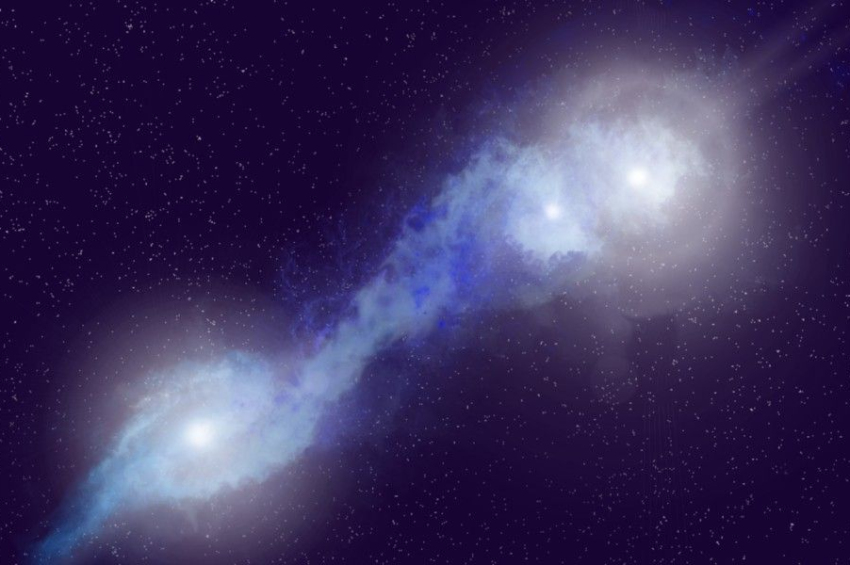
In millions to billions of years there will be an enormous galaxy with a gargantuan black hole.
Astronomers have identified a remarkable system of three supermassive black holes located roughly 1.2 billion light years from Earth in a region of space where three galaxies are in the process of merging.
This system, designated J1218/1219+1035, offers an unprecedented observational window into how massive galaxies and their central black holes grow and interact over cosmic time, a team from the American Astronomic Society said in a study published in The Astrophysical Journal Letters.
Each of the three black holes resides at the heart of its own galaxy and is actively accreting material, causing them to emit powerful energy in the form of radio jets and bright radio light.
More to read:
Astronomers discover black hole that sucks fuel out of its host galaxy
“Triple active galaxies like this are incredibly rare, and catching one in the middle of a merger gives us a front row seat to how massive galaxies and their black holes grow together,” astrophysicist Emma Schwartzman of the US Naval Research Laboratory, said in a statement for the National Radio Astronomy Observatory.
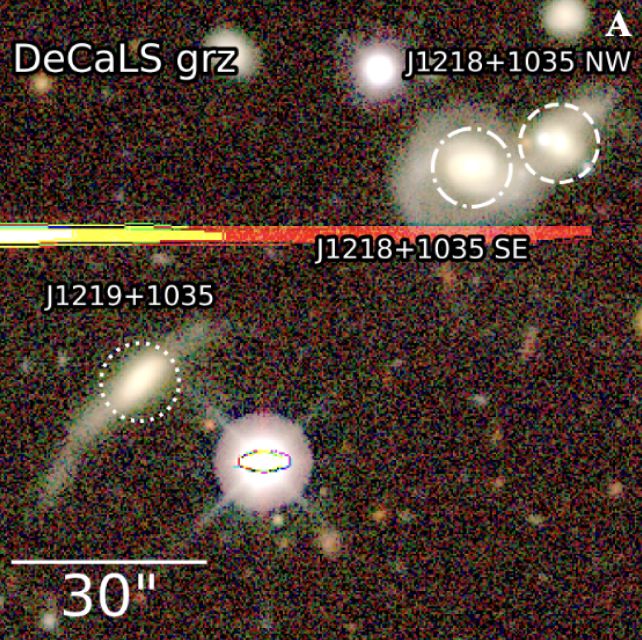
The discovery is significant not only because of the sheer scale of the system but also because it moves a theoretical concept into observational reality.
“By observing that all three black holes in this system are radio bright and actively launching jets, we’ve moved triple radio-active galactic nuclei (AGN) from theory into reality and opened a new window into the life cycle of supermassive black holes,” Schwartzman noted.
The three galaxies involved are not yet fully coalesced but are gravitationally bound in what astronomers describe as a rare triple merger event.
More to read:
Early Universe galaxies got killed by their supermassive black holes
Galaxy mergers on their own are well established as a primary mechanism for galactic evolution, and evidence suggests the Milky Way experienced at least three major mergers in its 13 billion year history. However, finding three galaxies merging simultaneously — each with its own active supermassive black hole — is exceedingly uncommon.
Although the three black holes are currently moving toward mutual interaction, the actual merger into a single, larger black hole will take millions to billions of years.
Even on cosmic timescales, such processes unfold slowly, but astronomers consider this system a living laboratory for studying the dynamics of black hole growth, gravitational interactions, and galaxy evolution.