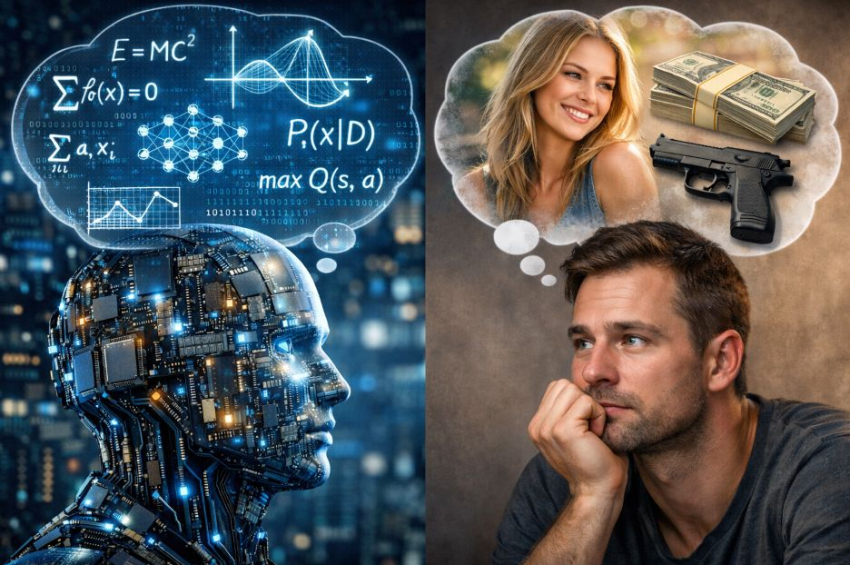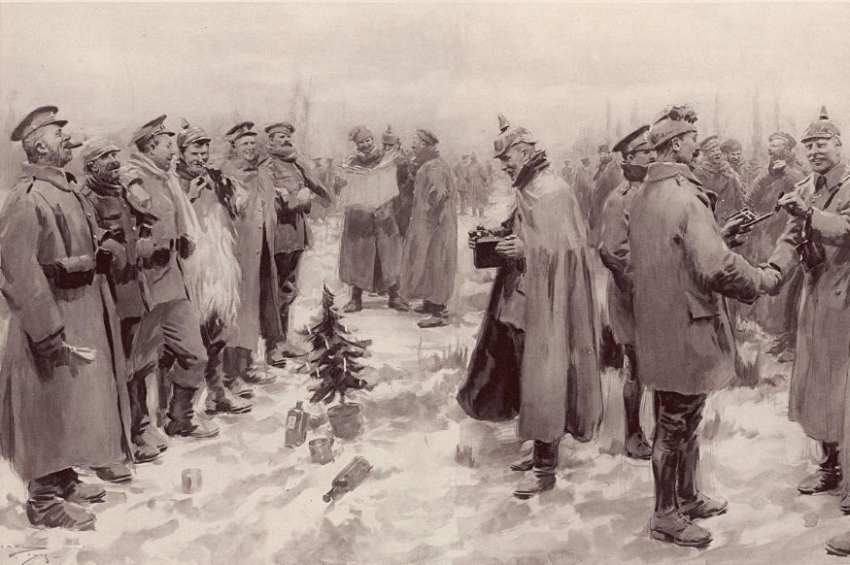
What is the connection between a comet and human stupidity?

Netflix's blockbuster is very timely as science is ignored by politicians and reduced to conspiracy by the masses, so the 138-minute film is a must-watch for all family members who are not restricted by age.
"Don't Look Up" brings to the fore two astronomers, who discover a comet hurtling toward Earth and try to warn the government, media, and everyone that something must be done to prevent a collision with our planet. The scholars’ desperation grows by the day, because no one takes them seriously - the president, under a strong influence of an oligarch, is in the heat re-election, journalists who have promised coverage are more concerned with high ratings, and common people feel it’s about a new conspiracy.
Deja vu
Does this story sound familiar? We saw something similar during the pandemic: leaders swearing there was no cause for concern, media mixing fakes with facts, and high school graduates explaining the role of vaccines through the lens of genetic mutations.
A comet heading towards a planet at a speed of tens of thousands of kilometers per hour should be a very serious thing, but screenwriters Adam McKay and David Sirota inserted funny moments into the movie. Some comic sequences make viewers forget for a few moments that it’s actually about the apocalypse.
The nation’s president, for example, enjoys the margin of error of about 1% of astronomers' calculations and overlooks the other almost 99% of the certainty that the impact will occur. The oligarch who sponsored her election doesn't mind that a third of the rockets and robots he had sent to collect ore from the comet have gone out of commission prematurely.
The hosts of the TV show, who are in a constant exchange of cheap jokes, are bothered by the guests’ look, but don't care for what they say.
In essence we get a cocktail of chiseled linguistics, twisted mathematics, distorted reality.
The freedom to choose what to hear and see has allowed people to select the channels of communication that are suitable for their own beliefs, expectations and fears, that are the least disturbing, and this informational comfort causes them to lose their sense of reality and state of alert to external dangers.
It is that state of alertness that our ancestors had developed for more than hundreds of thousands of years and thanks to which we have survived as a species.
Ancient Greeks on anticipatory thinking
As an example, we will refer to global warming - another overlooked disaster. One of the problems that’s been largely ignored is the role of humans in climate change. The first debates about the impact of people on climate were documented in Ancient Greece in 1200 BC – 300 AD. Greek philosophers wondered if drying up swamps and cutting down forests had anything to do with the timing and intensity of rainfalls.
More recently, in 1896 the Swede Svante Arrhenius became the first scientist to imagine how humans can modify the climate on a global scale. He published a paper with figures and arguments how carbon dioxide emissions could warm the planet.
The first article in the media about rising temperatures as a result of burning coal was published in the American magazine Popular Mechanics in 1912.
And in 1957, scientist Roger Revelle told the whole world - after completing two major experiments - that the oceans would be unable to absorb the entire volume of carbon dioxide emitted by world industry.
Scientists rang the alarm bells at the Conference on Atmospheric Change in Toronto, Canada, in 1988.
Since then, 99% of the scientific community keeps ringing all the bells, so that only in 1997 did some of the world's leaders sign the Kyoto Protocol, and in 2021 adopted a timid plan to transition to renewable energy and restore ecosystems.
How vaccines turned from saviors into "killers"
Another case study is the global COVID-19 pandemic. In the midst of the SARS-CoV-2 debate, it seems that everyone is forgetting an indisputable truth: the generations born during the past 100 years have avoided the deadliest diseases of the past centuries thanks to mass immunization, and we are alive today because our parents vaccinated us. And this is a proven fact.
The last pandemic has divided the world into two camps: those who believe that vaccination is a lifeline and those who believe that vaccines are either ineffective or dangerous.
The second group of people readily accepts a conspiracy-based explanation, but doesn't give a damn about the arguments from science. Refusal to vaccinate results in the perpetuation of the pandemic, with new cases of infection and new deaths.
Some diseases had such a powerful impact that they changed the course of history. For example, during the Hundred Years War between England and France the sides had to cease military operations for several years due to the plague that was haunting Europe (Black Death).
Here is another example. In 1812, determined to personally humiliate Russian Tsar Alexander I, Napoleon decided to end the campaign in Russia because the army was losing more soldiers to typhus than on the battlefield.
One of the most successful examples, however, is the subjugation of the American continents by European colonists. The latter brought to the New World the whole bunch of diseases they were suffering from in Europe, against which the natives had no immunity whatsoever. During the 100 years that the colonization process lasted, 90% of the Amerindian population died, that counts for hundreds of millions of people - a true genocide!
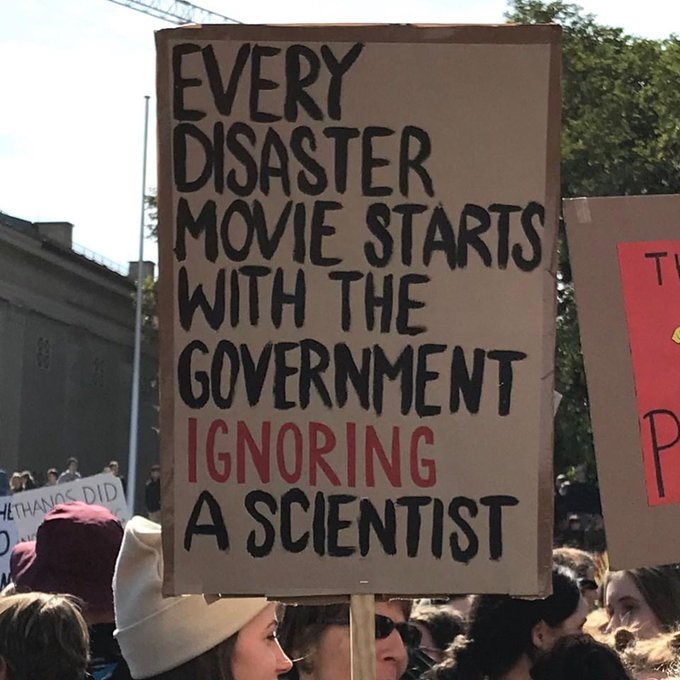
A protest against the indifference of US authorities: ”Every disaster movie starts with the government ignoring a scientist.”
The enormous leap in medicine and related sciences in the past 150 years is unprecedented. During the last 4-5 decades, a number of serious diseases has been eradicated or limited to a few cases per year. Remember poliomyelitis, typhus, measles, smallpox, cholera, tuberculosis, etc.
We should also keep in mind that shortly after birth all children are immunized against these extremely dangerous diseases. Our luck that being children no one asked us if we wanted to be injected with vaccines, which in the end left only light scars in the shape of a flower on our shoulders. How many of us would have come to think about vaccines without being immunized as children is an open question.
People who say that vaccines are intended to sterilize humans have no idea how economy works. In a normal economy you have to show advertising to someone, sell them goods and offer them services. Cars and animals don't need all that. Neither robots and autonomous machines. Humans do. So, economy needs humans.
And those who are afraid of being chipped by immunization must know one thing very clearly: if it comes to that, we will put microchips under the skin or swallow them without anyone forcing us - for the simple reason that it is cheaper and more convenient, be it communication gadgets, IDs or nanomedicines. And they certainly cost more than $40-50 - the price of the most expensive dose of a coronavirus vaccine. These themes are well reported HERE, HERE, HERE and HERE.
Going back to our tragicomedy with the comet. By wrapping the movie "Don't Look Up" in a satirical format, the director and his team wanted to convey a readable message to the viewers, and namely this: if science continues to be neglected, and obsession with profit at any cost gets out of control, all the technology we have and heroism we are capable of will be useless, because
the synergy between an idiot in the government and an idiot with a lot of money (and other individuals unfriendly to reasoning) leaves little chance for any number of scientists of whatever rank.
A curious fact about this movie is that technology was capable of predicting exactly how the nation's leader would end up (eaten by a brontoroc on another planet, many years from now), but it was unable to sense the wrong decisions. And that suggests a sad conclusion: human stupidity, unfortunately, beats technology while a comet doesn't care about either.
It remains to be seen whether famous actors Leonardo DiCaprio, Meryl Streep, Jennifer Lawrence, Cate Blanchett and others will succeed in convincing the public that scientists should be trusted. At least when we face major dangers like the global pandemic, climate change, or a comet the size of Mount Everest.
***
This text was originally published on our website in Romanian, here.
If you like our comment on this topic, please support us by donating to this website. You may also subscribe by clicking on any premium article. Enable us to write more about science and technology. Any amount is welcome. Thank you.
Beneficiary: Rudeana SRL
Bank: Banca Transilvania, Romania
IBAN in euros: RO50BTRLEURCRT0490900501